
Introduction
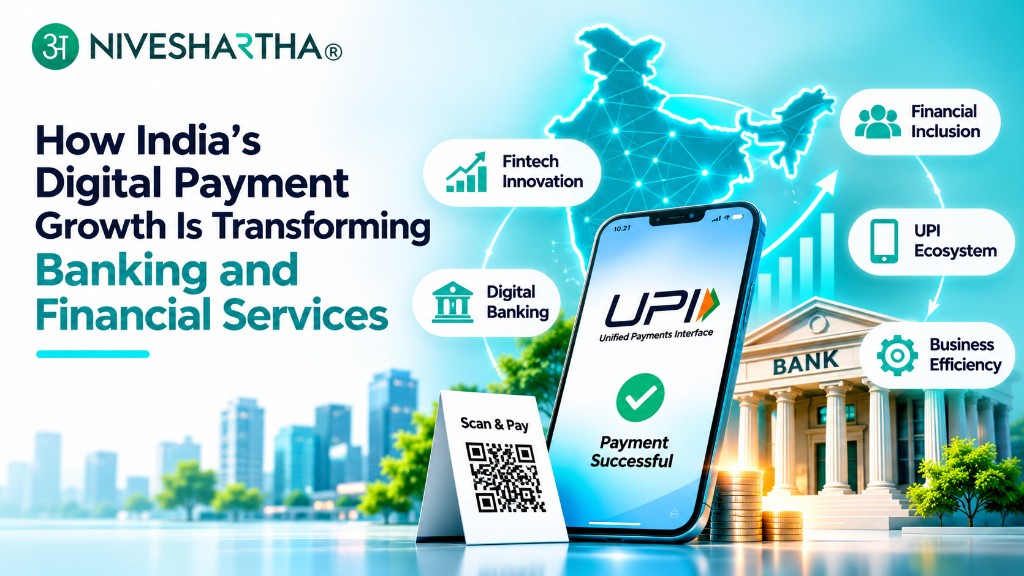
India's financial landscape has changed significantly with the growing adoption of digital payment systems. From local shops accepting QR code payments to businesses using online banking platforms, digital transactions have become an important part of everyday economic activity.
The development of the Unified Payments Interface (UPI), mobile banking, payment gateways, and financial technology platforms has contributed to this transformation.
However, digital payment growth in India is not limited to transaction convenience. It is also influencing banking operations, business models, financial inclusion, and competition within the financial services industry.
For stock market investors, understanding these developments provides useful insights into how India's financial sector is evolving.
1. Understanding India's Digital Payment Ecosystem
India's digital payment ecosystem includes technologies and financial institutions that enable electronic transfers between individuals and businesses.
Important components include:
- UPI: Enables instant bank-to-bank payments through participating applications.
- Mobile Banking: Allows customers to access banking services using smartphones.
- Payment Gateways: Help businesses accept online payments.
- Digital Wallets: Enable electronic payments and other supported financial transactions.
- Banking Infrastructure: Supports payment processing, settlement, security, and regulatory compliance.
These systems operate through interconnected networks involving banks, technology providers, payment service providers, and regulatory institutions.
2. How UPI Is Changing Banking Services in India
The Unified Payments Interface, developed by the National Payments Corporation of India (NPCI), has become an important part of India's digital payment infrastructure.
UPI enables users to transfer funds between participating bank accounts without requiring traditional payment details for every transaction.
Reduced Dependence on Cash
Digital payments offer an alternative to physical cash for many everyday transactions.
This can simplify payment collection and reduce certain cash-handling requirements for businesses.
Changing Customer Expectations
Customers increasingly expect convenient digital banking services, accessible payment applications, and efficient transaction processing.
Banks must continuously develop their technology infrastructure to meet these expectations.
Greater Technology Investment
Banks invest in cybersecurity, payment processing systems, application development, and digital customer support.
While these investments can improve service delivery, they also create operational and technology-related expenses.
3. The Role of Fintech Companies in Digital India's Growth
Financial technology companies, commonly known as fintech companies, use technology to provide or support financial services.
Their activities may include digital payments, lending technology, insurance distribution, financial software, and banking infrastructure.
How Fintech Businesses Operate
Different fintech companies follow different revenue models.
Some generate revenue through merchant services, software subscriptions, payment processing arrangements, or technology partnerships.
Others operate platforms that connect financial institutions with customers.
Higher transaction volumes do not automatically mean higher profitability.
Financial performance depends on revenue generation, operating expenses, customer acquisition costs, competition, and regulatory requirements.
4. Digital Payments and Financial Inclusion
Financial inclusion refers to improving access to useful and affordable financial services.
Digital payment infrastructure can support this objective by making electronic transactions accessible to more individuals and businesses.
Benefits for Small Businesses
Small retailers and service providers can accept digital payments without relying exclusively on cash.
Electronic transaction records may also help businesses monitor collections and maintain financial records.
Access Beyond Major Cities
Digital banking services can reduce the need for some in-person banking activities.
However, internet connectivity, smartphone access, digital literacy, and cybersecurity awareness remain important challenges.
Digital adoption therefore needs to be examined alongside accessibility and consumer protection.
5. How Digital Payment Growth Influences Banking Stocks
Banks play an important role in the digital payment ecosystem by maintaining customer accounts and supporting payment infrastructure.
Digital adoption can influence banking businesses through several channels.
Operational Efficiency
Technology can automate certain banking processes and reduce manual activities.
However, savings depend on implementation costs, system maintenance, transaction volumes, and operating efficiency.
Customer Engagement
Digital platforms may help banks improve customer access and service availability.
A larger digital customer base can create opportunities for additional banking services, subject to customer needs and applicable regulations.
Technology and Security Costs
Banks must invest in reliable systems, fraud prevention, cybersecurity, and regulatory compliance.
Consequently, digital expansion does not necessarily improve profitability immediately.
Investors should examine financial indicators such as return on assets, cost-to-income ratios, deposit growth, fee income, and technology expenditure.
6. Impact on India's Broader Financial Services Sector
Digital payment adoption also affects businesses beyond traditional banking.
| Industry | Potential Influence |
|---|---|
| Banking | Digital services, customer engagement, technology expenditure |
| Fintech | Payment solutions, merchant services, financial software |
| IT Services | Demand for banking technology and cybersecurity systems |
| Retail | Electronic collections and payment convenience |
| Financial Infrastructure | Transaction processing, security and network development |
These developments may influence business activity, but the financial outcome differs across companies.
A business operating in a growing industry is not automatically an attractive investment.
7. Risks and Challenges in the Digital Payment Ecosystem
Despite the development of digital payment infrastructure, several challenges remain.
Cybersecurity and Fraud
Digital transactions require strong security systems to protect users and financial information.
Fraudulent payment requests, phishing, and unauthorised access can create financial and reputational risks.
Regulatory Changes
Payment service providers and financial institutions operate within regulatory frameworks.
Changes in compliance requirements can influence operating costs and business models.
Competition and Revenue Pressure
Competition among payment platforms may limit transaction-related revenue opportunities.
Companies must balance customer growth with sustainable operating economics.
Technology Dependence
System outages, infrastructure limitations, and processing failures can affect payment services.
These risks highlight the importance of evaluating operational reliability alongside business expansion.
8. What Should Investors Analyse in Digital Banking and Fintech Companies?
Investors examining businesses connected to digital payments should consider more than transaction growth.
Important research areas include:
- Revenue Model: How does the company generate income from its services?
- Profitability: Are operating margins and earnings improving?
- Technology Investment: How much does the company spend on infrastructure and security?
- Regulatory Exposure: What requirements influence the business?
- Competitive Position: How does the company differentiate its services?
- Valuation: Does the current share price reflect reasonable expectations about future performance?
A company may experience strong user growth while continuing to face profitability challenges.
Similarly, an established financial institution may benefit from digital adoption without experiencing immediate changes in its share price.
9. Digital Payment Growth and the Indian Stock Market
Digital payment adoption reflects broader changes in consumer behaviour, financial infrastructure, and business technology.
These developments can influence investor expectations about banking, fintech, and technology-related companies.
However, stock prices depend on several factors, including company earnings, valuations, interest rates, market sentiment, competition, and economic conditions.
Growth in the digital payment ecosystem should therefore be considered one component of a broader investment research process.
Conclusion
India's digital payment transformation is influencing how individuals, businesses, and financial institutions interact.
UPI, mobile banking, and fintech platforms have contributed to changes in payment convenience, financial accessibility, and banking operations.
For investors, the important question is not simply how quickly digital payments are expanding, but how businesses convert technological adoption into sustainable financial performance.
At NiveshArtha, a SEBI-registered Research Analyst firm, we focus on research-based market insights by examining company fundamentals, sector developments, economic conditions, and associated risks.
Learn more about our research services at https://niveshartha.com/.
Niveshartha
Nov 10, 2026
Get in touch with us
Recent Posts
Start investing today, for a better tomorrow
If you’d like to talk to our executive kindly call us on +91 8884014014 during 9 am - 5 pm weekdays.
Start investing today, for a better tomorrow
If you’d like to talk to our executive kindly call us on +91 8884014014 during 9 am - 5 pm weekdays.


*Disclaimer: “Registration granted by SEBI, Enlistment as RA with Exchange and certification from NISM in no way guarantee performance of the intermediary or provide any assurance of returns to investors.”
*Disclaimer: For security/securities displayed in the website and in the advertisement - “The securities quoted (If any) on our website or in any of our advertisement are for illustration only and are not recommendatory.”
*Standard warning: “Investment in securities market are subject to market risks. Read all the related documents carefully before investing.”
*Mandatory notice: “Clients shall be requested to go through Do’s and Don’ts while dealing with RA as specified in SEBI master circular no. SEBI/HO/MIRSD-POD- 1/P/CIR/2024/49 dated May 21, 2024 or as may be specified by SEBI from time to time.”
Note: We have changed our pricing with effective from 01/12/2024.
Niveshartha ©2026 All Rights Reserved.
Developed by Techisor