
Introduction
The Indian stock market is influenced by economic developments, interest rate decisions, global business activity, and changing investor expectations. However, these factors do not affect every industry in the same way.
Two important sectors that demonstrate this difference are Banking and Information Technology (IT).
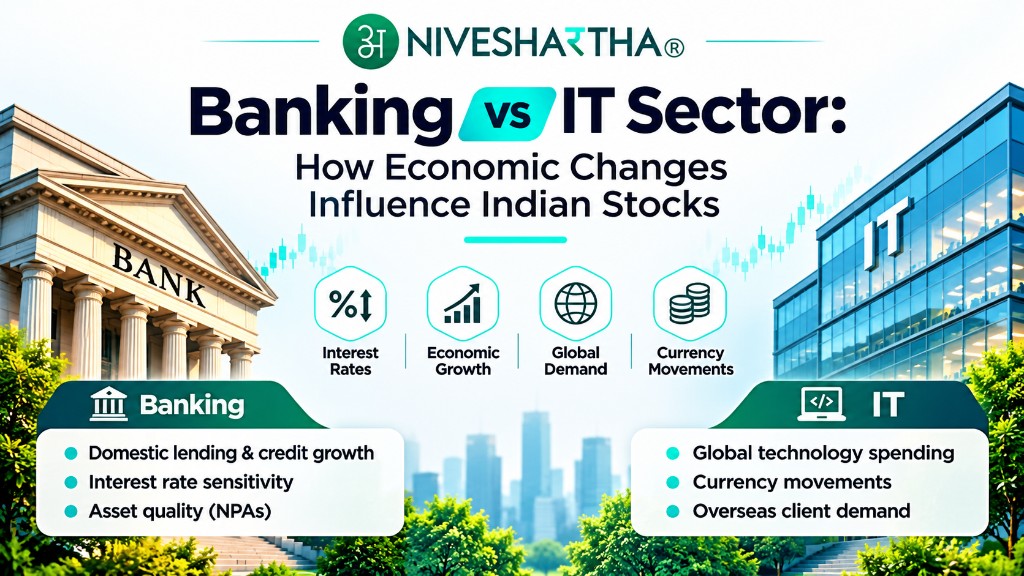
While banking companies are closely connected to domestic lending, interest rates, and economic activity, IT companies often depend on international technology spending, overseas clients, and currency movements.
But how do these differences influence their stock prices?
Understanding the Banking vs IT sector comparison helps investors examine how economic changes affect businesses and why sector-specific research matters when analysing Indian stocks.
1. Understanding the Banking Sector in India
The banking sector plays an important role in India's financial system by facilitating deposits, lending, payments, and other financial services.
Banks generate income primarily through lending activities, investments, and service-related fees.
Key Factors Influencing Banking Stocks
- Interest Rates: Changes in lending and deposit rates can influence profitability.
- Credit Growth: Demand for loans may increase or decrease with economic activity.
- Asset Quality: Non-performing assets (NPAs) can affect earnings and financial stability.
- Deposit Growth: Banks require adequate funding to support lending operations.
- Regulatory Developments: RBI policies influence banking operations and financial requirements.
Banking stocks may respond to changes in domestic economic conditions, but their performance also depends on individual banks' financial strength and operational efficiency.
2. Understanding the Indian IT Sector
India's Information Technology sector provides services such as software development, consulting, cloud solutions, digital transformation, and technology support.
Many Indian IT companies serve clients across North America, Europe, and other international markets.
Consequently, their business performance is influenced by global economic conditions.
Key Factors Influencing IT Stocks
- Global Technology Spending: Client technology budgets influence demand for IT services.
- Currency Movements: Exchange rate fluctuations can affect reported revenue and expenses.
- Client Demand: Changes in international business activity may influence project spending.
- Operating Margins: Employee expenses and project costs affect profitability.
- Technology Developments: Artificial intelligence, automation, and cloud adoption influence service requirements.
Unlike banking companies, which are strongly connected to domestic financial activity, many IT businesses have significant exposure to international markets.
3. Banking vs IT Sector: Key Differences
Although both sectors contribute to India's economy, their business models and economic sensitivities differ.
| Comparison Factor | Banking Sector | IT Sector |
|---|---|---|
| Primary Business | Lending and financial services | Technology and digital services |
| Major Demand Driver | Domestic credit demand | Domestic and global technology spending |
| Interest Rate Exposure | Direct influence on lending and funding costs | Indirect influence through client spending |
| Currency Exposure | Depends on foreign currency assets and liabilities | Often significant due to overseas revenue |
| Important Financial Indicators | NIM, NPAs, credit growth | Revenue growth, margins, deal pipeline |
| Major Risks | Credit defaults, liquidity, funding costs | Global slowdown, client spending, competition |
These differences show why a single economic development may influence banking and IT companies differently.
4. How RBI Interest Rate Decisions Affect Banking Stocks
The Reserve Bank of India (RBI) uses monetary policy instruments, including the repo rate, to influence financial conditions.
Changes in interest rates can affect banks through lending rates, deposit costs, and credit demand.
When Interest Rates Rise
Higher interest rates may increase borrowing costs for businesses and consumers.
Banks may experience changes in loan demand, funding costs, and net interest margins.
When Interest Rates Fall
Lower interest rates may support borrowing activity under certain economic conditions.
However, the effect on bank profitability depends on how quickly lending rates and deposit costs adjust.
An interest rate change does not automatically produce the same financial outcome for every bank.
Asset quality, deposit composition, and lending portfolios remain important considerations.
5. How Global Economic Conditions Influence IT Stocks
Indian IT companies often provide services to international businesses.
As a result, global economic growth and corporate technology spending can influence their financial performance.
During Strong Global Business Activity
Companies may increase spending on technology infrastructure, software development, cloud services, and digital transformation.
This can influence demand for IT services.
During Economic Uncertainty
International businesses may delay projects, reduce discretionary technology spending, or reconsider outsourcing budgets.
Such developments can affect IT companies depending on their client exposure and service offerings.
Therefore, analysing IT sector stocks in India requires understanding both company fundamentals and international economic conditions.
6. Currency Movements: Why the Rupee Matters for IT Companies
The Indian rupee's exchange rate against international currencies can influence businesses with overseas revenue.
For example, an IT company receiving payments in US dollars may experience changes in rupee-denominated revenue when exchange rates fluctuate.
However, currency movements also affect overseas expenses, employee costs, and hedging arrangements.
A depreciating rupee does not guarantee higher profitability for IT companies.
Similarly, banks with foreign currency exposures may experience different effects depending on their financial positions.
Currency analysis should therefore consider each company's business structure rather than relying on exchange rate movements alone.
7. Financial Indicators to Examine in Both Sectors
Research analysts use different financial indicators when evaluating banking and IT companies.
Banking Sector Indicators
- Net Interest Margin (NIM): Measures net interest income relative to interest-earning assets.
- Gross and Net NPAs: Provide information about loan asset quality.
- Credit and Deposit Growth: Help assess lending activity and funding trends.
- Capital Adequacy Ratio: Indicates capital available relative to risk-weighted assets.
IT Sector Indicators
- Revenue Growth: Measures changes in business income.
- Operating Margin: Helps assess operating profitability.
- Client Concentration: Indicates dependence on major customers.
- Deal Pipeline: Provides information about potential business opportunities, subject to execution uncertainty.
These indicators should be examined alongside valuations, financial statements, and company-specific risks.
8. Risks and Challenges in Banking and IT Stocks
Both sectors face uncertainties that can influence financial performance and share prices.
Banking Sector Risks
- Increasing loan defaults and credit losses.
- Rising deposit and borrowing costs.
- Changes in monetary policy.
- Liquidity pressures and regulatory requirements.
IT Sector Risks
- Reduced international technology spending.
- Currency fluctuations.
- Competition and pricing pressure.
- Changes in technology and client requirements.
Neither sector can be considered universally safer or more suitable for every investor.
Risk levels vary between individual companies and may change with economic conditions.
9. How to Analyse Banking and IT Sector Trends
A structured sector analysis involves examining more than recent share price movements.
Investors may consider:
- Economic Indicators: Interest rates, GDP growth, inflation, and international economic activity.
- Company Financials: Revenue, profitability, cash flows, and financial stability.
- Sector Developments: Regulatory changes, technology demand, and industry competition.
- Stock Valuations: Market prices relative to earnings, assets, and growth expectations.
- Risk Factors: Business uncertainties, market volatility, and changing economic conditions.
Understanding these factors provides a broader perspective on sector performance.
However, no single indicator can reliably predict future stock prices.
Conclusion: Different Sectors, Different Economic Influences
Banking and IT are important components of the Indian stock market, but their performance is influenced by different economic factors.
Banking companies are closely connected to domestic credit conditions, interest rates, and asset quality. IT companies often have greater exposure to global technology demand, overseas economic activity, and currency movements.
Understanding these differences helps explain why banking and IT stocks may respond differently to the same economic developments.
At NiveshArtha, a SEBI-registered Research Analyst firm, we provide research-based market insights and recommendations by examining company fundamentals, sector developments, and market conditions.
Our focus is on supporting informed investment decisions through structured research and awareness of market risks.
To learn more about our stock market research services, visit https://niveshartha.com/.
Niveshartha
Nov 18, 2026
Get in touch with us
Recent Posts
Start investing today, for a better tomorrow
If you’d like to talk to our executive kindly call us on +91 8884014014 during 9 am - 5 pm weekdays.
Start investing today, for a better tomorrow
If you’d like to talk to our executive kindly call us on +91 8884014014 during 9 am - 5 pm weekdays.


*Disclaimer: “Registration granted by SEBI, Enlistment as RA with Exchange and certification from NISM in no way guarantee performance of the intermediary or provide any assurance of returns to investors.”
*Disclaimer: For security/securities displayed in the website and in the advertisement - “The securities quoted (If any) on our website or in any of our advertisement are for illustration only and are not recommendatory.”
*Standard warning: “Investment in securities market are subject to market risks. Read all the related documents carefully before investing.”
*Mandatory notice: “Clients shall be requested to go through Do’s and Don’ts while dealing with RA as specified in SEBI master circular no. SEBI/HO/MIRSD-POD- 1/P/CIR/2024/49 dated May 21, 2024 or as may be specified by SEBI from time to time.”
Note: We have changed our pricing with effective from 01/12/2024.
Niveshartha ©2026 All Rights Reserved.
Developed by Techisor