
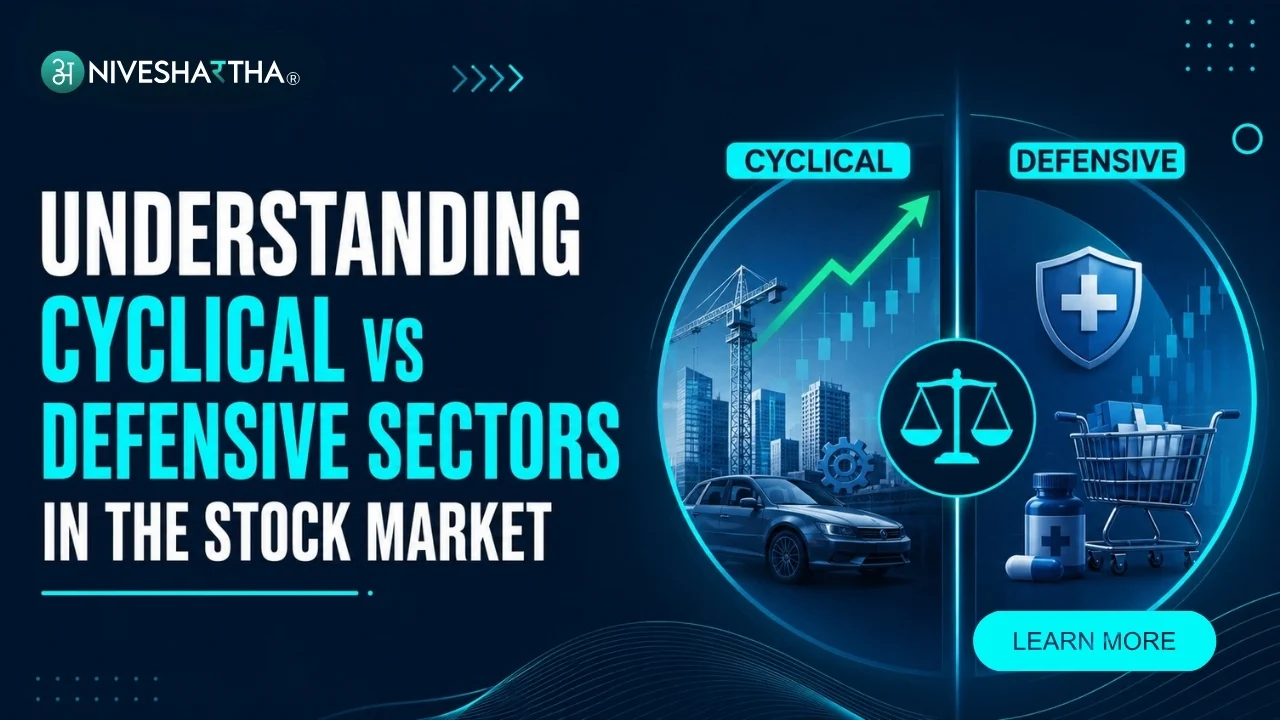
When it comes to Investing in stocks, understanding how different sectors respond to economic conditions can help investors interpret market movements more effectively. Not all sectors perform in the same way when the economy expands, slows down, or faces uncertainty. Two important classifications investors often come across are cyclical sectors and defensive sectors.
Knowing the difference between these sectors can provide useful context when evaluating companies, analysing market trends, and understanding how economic cycles influence stock prices.
What Are Cyclical Sectors?
Cyclical sectors are industries whose business performance tends to be closely linked to the economic cycle. When economic activity is strong, consumers and businesses generally spend more, which can support revenue and earnings growth for companies operating in these sectors.
However, when economic growth slows, demand for their products or services may decline, potentially putting pressure on earnings.
Examples of Cyclical Sectors
Common examples include:
- Automobiles – Vehicle purchases can increase when consumer confidence and income levels are strong.
- Real Estate – Property demand can be influenced by economic growth, interest rates, and consumer sentiment.
- Metals & Mining – Demand can rise with infrastructure development and industrial activity.
- Capital Goods – Companies can benefit when businesses increase spending on machinery and infrastructure.
- Consumer Discretionary – Spending on products and services beyond basic necessities often rises during stronger economic periods.
- Banking & Financial Services – Credit demand, economic activity, interest rates, and asset quality can influence performance.
What Are Defensive Sectors?
Defensive sectors generally provide products and services that people continue to need regardless of the broader economic environment.
Even during an economic slowdown, demand for essential goods and services may remain relatively stable. As a result, defensive businesses can sometimes experience less earnings volatility than highly cyclical businesses.
Examples of Defensive Sectors
Some commonly considered defensive areas include:
- FMCG – Everyday consumer essentials tend to have relatively consistent demand.
- Healthcare – Healthcare products and services remain important across economic cycles.
- Utilities – Electricity and other essential utility services generally have recurring demand.
- Consumer Staples – Essential household products can see more stable consumption.
This does not mean defensive stocks are immune to market declines. Their prices can still fluctuate because of valuation, interest rates, company-specific developments, and broader market sentiment.
Cyclical vs Defensive Sectors: Key Differences
| Factor | Cyclical Sectors | Defensive Sectors |
|---|---|---|
| Economic sensitivity | Higher | Generally lower |
| Demand | Often varies with economic conditions | Usually more stable |
| Performance in expansions | Can benefit significantly | May grow more steadily |
| Performance in slowdowns | Can face greater pressure | May show relative resilience |
| Earnings volatility | Generally higher | Generally lower |
| Typical examples | Auto, Metals, Real Estate | FMCG, Healthcare, Utilities |
Why Do Economic Cycles Matter?
Economic cycles can influence corporate earnings, consumer spending, investment activity, borrowing, and business confidence.
During an economic expansion, businesses may increase production, consumers may spend more, and companies may invest in new capacity. This environment can support cyclical sectors.
During an economic slowdown, consumers and businesses may become more cautious. Spending on discretionary products can weaken, while essential products and services may continue to see demand. This can make defensive sectors relatively attractive from a stability perspective.
However, sector performance is influenced by multiple factors, so investors should avoid assuming that a particular sector will always outperform simply because the economy is in a specific phase.
How Interest Rates Can Affect Different Sectors
Interest rates are another important factor when analysing sectors.
Higher interest rates can increase borrowing costs for companies and consumers. This can affect interest-sensitive industries such as real estate, automobiles, and capital-intensive businesses.
On the other hand, financial companies can be affected by interest-rate changes through lending activity, margins, credit demand, and asset quality.
For defensive sectors, the impact may be different. Their relatively stable demand can provide some support, but valuations can still be affected when interest rates change.
Should Investors Choose Only Defensive or Cyclical Stocks?
There is no universal answer.
The appropriate approach depends on factors such as:
- Investment objectives
- Risk tolerance
- Valuation
- Economic conditions
- Company fundamentals
- Portfolio diversification
- Investment horizon
Instead of categorising a stock purely by sector, investors can also examine its revenue growth, profitability, debt levels, cash flows, competitive position, valuation, and management quality.
A strong company in a cyclical sector may have very different characteristics from a weaker company in a defensive sector.
The Importance of Diversification
Understanding cyclical and defensive sectors can also help investors think about diversification.
A portfolio concentrated entirely in one type of sector may become more exposed to specific economic conditions. Holding companies from different industries can potentially reduce dependence on the performance of a single sector.
However, diversification does not eliminate market risk or guarantee returns. Investors should evaluate each investment based on its own fundamentals and suitability for their objectives.
Final Takeaway
Cyclical and defensive sectors react differently to changes in economic activity. Cyclical sectors can be more sensitive to economic growth and consumer spending, while defensive sectors generally benefit from more consistent demand for essential products and services.
Understanding these differences can help investors make better-informed decisions when analysing the market. For those exploring Investing in stocks, research-based analysis and an understanding of economic cycles can be valuable tools.
NiveshArtha provides research-based market insights to help investors better understand companies, sectors, and market developments.
Niveshartha
August 16, 2026
Get in touch with us
Start investing today, for a better tomorrow
If you’d like to talk to our executive kindly call us on +91 8884014014 during 9 am - 5 pm weekdays.
Start investing today, for a better tomorrow
If you’d like to talk to our executive kindly call us on +91 8884014014 during 9 am - 5 pm weekdays.


*Disclaimer: “Registration granted by SEBI, Enlistment as RA with Exchange and certification from NISM in no way guarantee performance of the intermediary or provide any assurance of returns to investors.”
*Disclaimer: For security/securities displayed in the website and in the advertisement - “The securities quoted (If any) on our website or in any of our advertisement are for illustration only and are not recommendatory.”
*Standard warning: “Investment in securities market are subject to market risks. Read all the related documents carefully before investing.”
*Mandatory notice: “Clients shall be requested to go through Do’s and Don’ts while dealing with RA as specified in SEBI master circular no. SEBI/HO/MIRSD-POD- 1/P/CIR/2024/49 dated May 21, 2024 or as may be specified by SEBI from time to time.”
Note: We have changed our pricing with effective from 01/12/2024.
Niveshartha ©2026 All Rights Reserved.
Developed by Techisor